How to integrate MYOB AccountRight and Essentials with Hike
Hike offers built-in integration with MYOB AccountRight, a seamless connection between your point of sale solution and accounting software.
By pairing Hike and MYOB AccountRight, retailers can forgo laborious manual data entry, with precise accuracy of your data, that goes directly from Hike to your MYOB AccountRight account.
Hike offers seamless integration with MYOB AccountRight to automatically sync following records:
- Products, inventory
- Customers profiles
- Sales transactions, payments & Discounts given
- Credit notes, Layby & on account sales
- Purchase orders, Supplier profiles
- Stocktake, inventory change log
- Gift cards sales & redemptions (with proper liability allocation/reduction in MYOB AccountRight)
- Loyalty points earned & used (with liability allocation/redemption in MYOB AccountRight)
Note: If you’re using Hike on multiple outlets, you can link those outlets to separate MYOB AccountRight organisations. Get accurate sales history and more automatically posted to MYOB AccountRight for all your outlets.
Important steps before you begin
Before you start the integration, we strongly recommend you speak to your accountant to discuss the accounts you’d like to post data from Hike to MYOB AccountRight. Please ensure that MYOB AccountRight’s Chart of Accounts has all the accounts that you require for mapping, especially in relation to:
- Do you have a refund account already created in MYOB AccountRight?
- Corresponding payment types in MYOB AccountRight
- Expense and liability accounts for loyalty points
- Payment and liability accounts for gift cards
- Revenue & COGS accounts designation for Inventory & non-inventory items
- Asset account for inventory
- Corresponding names for Hike payment methods in MYOB AccountRight & related banking accounts
For instructions on how to edit or add accounts in your MYOB AccountRight’s Chart of Accounts, please click here
Disclaimer: Throughout this article, we’ve made some suggestion regarding account types selection in MYOB AccountRight’s Chart of Accounts. However, those suggestions are only for tutorial purposes only. We strongly recommend you speak to your accountant to obtain a professional advice before deciding on accounts mapping criteria and selections for your business account.
Let’s start setting up the MYOB AccountRight integration
You’ll setup the integration in 3 main steps:
Activate Hike & MYOB AccountRight or Essentials connection
- In Hike, open the Store setup tab, click Add-ons, and activate the MYOB add-on.
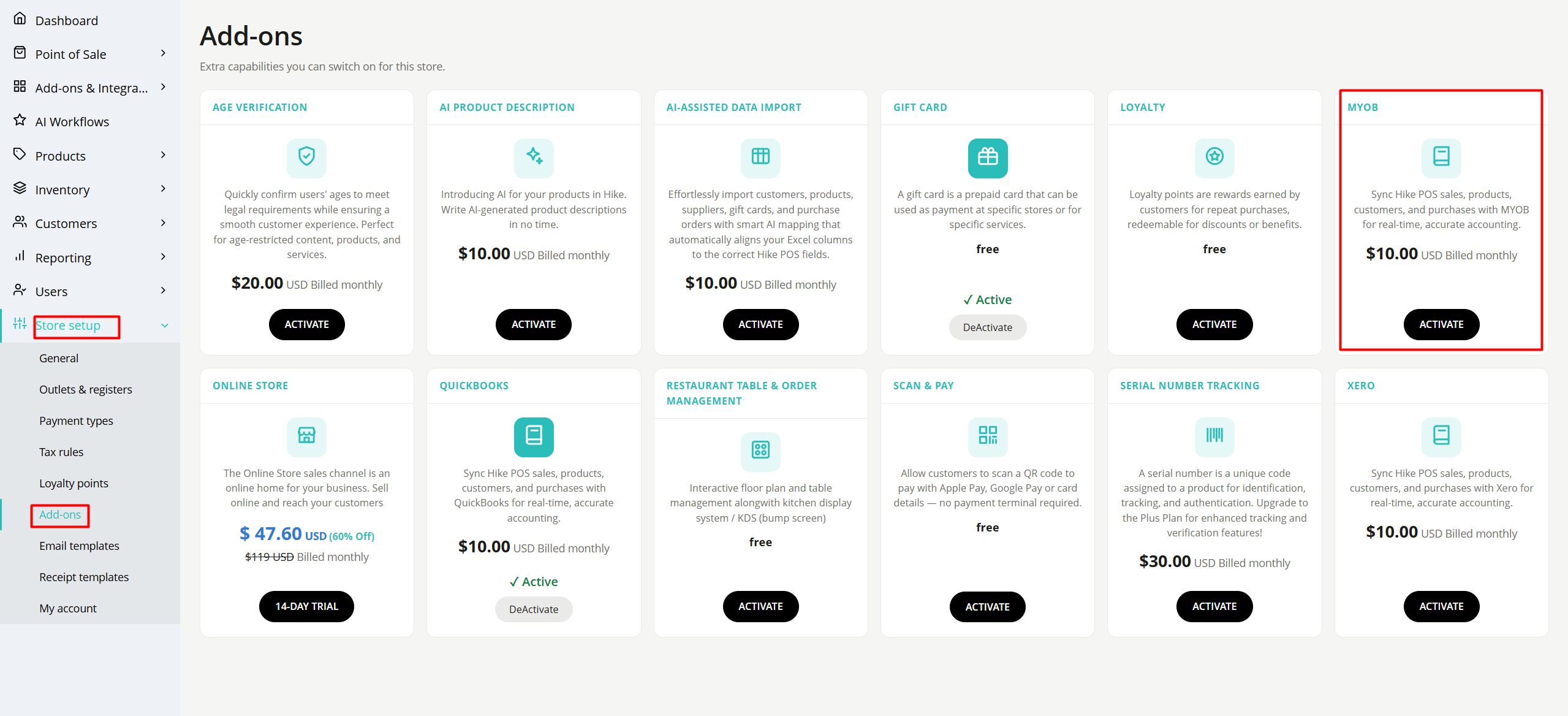
Integrate your MYOB account by clicking on Activate button.
3. You will then be directed to the Login page of MYOB AccountRight.
4. Login using your MYOB AccountRight credentials (Note: If you’ve already logged into your MYOB AccountRight account, MYOB AccountRight will automatically skip this step for you.)
5. Click on the Allow Access button to authorise Hike to sync with MYOB AccountRight.
6. Once your connection to MYOB AccountRight is active, you’ll automatically be redirected to the MYOB AccountRight integration settings screen in Hike.
Note: If you want to make sure that your MYOB AccountRight integration with Hike has successfully been activated, Close the settings screen, and you’ll land back on Hike’s Integrations list page. You’ll notice that next to the MYOB AccountRight Integration row, the Activate option has been replaced with Manage, which means you have successful activated the Hike + MYOB AccountRight connection.
Map MYOB AccountRight accounts
This is where we’ll map relevant account types in Hike to define how your data will be posted to MYOB AccountRight.
For example, if you are selling gift cards in Hike, by mapping a MYOB AccountRight liability account for it, you will be able to track the increase and decrease in your liability relating to gift cards sales.
Hike Outlet for Inventory Sync
Select the outlet to sync data to/from MYOB AccountRight.
If you’re using Hike on multiple outlets, you can link those outlets to separate MYOB AccountRight organisations by setting up connection for each outlet separately. Get accurate sales history as Hike automatically posts to MYOB AccountRight for all your outlets.
Generic Customer Name for Cash Sale Transactions
Select a common customer name for walk-in sales. All cash/walk-in sales will be sync’d to MYOB AccountRight under this customer profile. Even though you won’t receive customer information to engage with them further if a generic name is used, you can still identify shopping trends, for all your walk-in customers.
Inventory products
Sales (Revenue) account for inventory items
Select a default sales/revenue account for your inventory products.
Purchase (COGS) account for inventory items
This is your default cost of goods sold (COGS) account for inventory products. Your cost-of-goods-sold (COGS) refer to the expenses involved in creating or purchasing the products that your store sells.
PLEASE NOTE: Hike also lets you set product specific Revenue and COGS accounts for each of your product. However, if nothing is specified at a product level, the above default accounts will be used to post revenue and COGS amounts.
Inventory asset account
Select an asset account in MYOB AccountRight for your inventory. This is where inventory movement will get recorded because of a sale, purchase, stocktake or returns.
Adjustment (rounding) account for inventory
When undertaking a stocktake, you may find some discrepancies (and even occasional gains). Hike will record all inventory spillage/spoilage under this account.
Don’t have an inventory adjustment account? Create a new account in MYOB AccountRight's Charts of Accounts. Normally, this is an Expense account.
Non-Inventory Product
Sales (Revenue) account for non-inventory items
Select one of the revenue accounts from MYOB AccountRight’s Chart of Accounts, to be populated here. This is the account you will allocate revenue/income generated, from the sales of products or services with inventory tracking disabled.
Purchase (COGS) account for non- inventory items
When you sell a non-inventory item, the costs associated with that item will be recorded to this account.
PLEASE NOTE: Hike also lets you set product specific Revenue and COGS accounts for each of your product. However, if nothing is specified at a product level, the above default accounts will be used to post revenue and COGS amounts.
Invoice Settings
This is where you will select how you’d like to sync your sale transactions from Hike to MYOB AccountRight.
Detail each invoice: This option is suitable if you prefer to sync each individual sale as an invoice in MYOB AccountRight. It provides you more visibility options into your transactions, however it also adds many more transactions into MYOB AccountRight’s sales transactions list.
Send summary by account: Sync your total sales summary for the day by simply posting totals to relevant accounts. The total transaction summary is sent to MYOB AccountRight as one big sale invoice at the end of the day when you close your cash register in Hike.
Please note: Hike will always sync ‘on account’ sales as individual transaction even if ‘Send summary by account’ is activated.
What works best: Sync details invoice or summary?
It depends on your industry, business size and what you wish to achieve from this integration. For example, some of our customers who run coffee shops, prefer to sync by sale summary as there are so many small transactions – mostly walk-ins with no customer details on the sale. There is little purpose for them to sync invoice details at it would unnecessarily clutter their Sales section in MYOB AccountRight.
However, our users in the furniture industry, do prefer to sync with detailed invoices for each sale, as almost every sale has a customer associated with it, and the invoices sizes are comparatively large.
Accounts for Payments
Refund Account
Refunds are automatically posted to your Sales as negative values, using the ‘sales – refunds = net sales’ formula. However, when sales totals are less than the refunded amounts, it will result in the posting of a negative sales total for the day. MYOB AccountRight does not allow for the creation of negative invoices. Therefore, anytime that the daily sales are LESS than the refund totals, Hike will post the refunds to the account you have specified here.
To create a new refund account in MYOB AccountRight:
Go to Chart of Accounts and click Add New and select Current Asset for account type. Name the account and tick the checkbox for Enable Payments.
Cash Rounding Expense Account
Small cash rounding cam occur with decimal values, tax calculations and cash payments. For example, if an invoice total is $10.12 and customer is paying with cash, it will result in a rounding of $0.02.
To create new rounding adjustment account in MYOB AccountRight:
Go to Chart of Accounts and click Add New and select Expense Account for account type. Name the account and save.
Account for Discount Given
Please specify a corresponding account in MYOB AccountRight for the discounts given to customers. You can either use a MYOB AccountRight Revenue or an Expense account here.
To create new account for Discounts Given in MYOB AccountRight:
Go to Chart of Accounts and click Add New and select Expense Account or Revenue Account for account type. Name the account and save.
Accounts for Liability & Expense
Important: If you have not already created a current liability account for store credit, gift cards or loyalty in MYOB AccountRight, ensure that you do so first and tick Enable Payments in the Edit Account screen. If Enable Payments is not ticked, your liability will not be reduced when these payment options are redeemed.
Store Credit Liability Account
Hike lets you create credit notes. Here you can map customer credits to the corresponding liability account in MYOB AccountRight. Whenever store credit is redeemed by a customer, your liability will be reduced in MYOB AccountRight.
Loyalty Liability & Expense Account
Please specify the loyalty liability and expense accounts if you’re using Hike’s Loyalty feature.
Loyalty points are posted to MYOB AccountRight as an expense and liability when a customer starts earning points. Whenever accrued loyalty points are used by customer as payment, your loyalty liability will be reduced in MYOB AccountRight.
Gift Card / Gift Certificate Liability
Using Hike’s gift card feature? Gift card sales are different from other products because they do not result in an income, unlike other products. With gift cards, you accept payments in exchange for the promise of providing goods and services later. As such, gift cards are recorded and posted to MYOB AccountRight as a liability when sold. Your liability amounts are reduced when a customer redeems the gift certificate.
Accounts for Cash Management
Here you will be mapping for cash movements in Hike so that they will be posted into MYOB AccountRight. Please note, incorrect mapping may result in wrong amounts posting or MYOB AccountRight may decline to sync the transaction.
Cash In/Out Account
Create an account to post additional cash that you add to or remove from your cash register.
To create new Cash In/Out account in MYOB AccountRight:
Go to Chart of Accounts and click Add Account and select Current Asset for account type. Name the account, check box for Enable Payments to this account and save.
Cash Float Account
Your opening and closing cash float will be recorded to this MYOB AccountRight account.
To create new Cash Float account in MYOB AccountRight:
Go to Chart of Accounts and click Add Account and select Current Asset for account type. Name the account, check box for Enable Payments to this account and save.
Cash Register Discrepancy Account
When you close your cash register at the end of the shift/day, Hike will prompt you to enter ‘actual’ counted amounts against amounts ‘recorded’ as received. This account will be used to record any cash discrepancies between your actual cash takings and expected cash takings in Hike.
To create new Cash Discrepancy account in MYOB AccountRight:
Go to Chart of Accounts and click Add Account and select Expense for account type. Name the account, check box for Enable Payments to this account and save.
Tip Account
Suggested account type: Liability or Income
Do you accept tips? If so, here is where you will define its corresponding account in MYOB AccountRight. The type of account will depend on how tips are processed in your business.
- Liability – Some Hike users record tips as liability as they normally distribute it amongst their staff. When recorded, tips are added as a liability and the liability is reduced when tips are paid out to the staff.
- Income - For some Hike users, where they don’t have external staff, tips are simply recorded as income for the business. In the above example, we’ve used the Other Revenue account in MYOB AccountRight to sync any cash received via tips. Tips are not their main business and hence recognised as ‘Other Revenue’.
MYOB AccountRight account for freight charges
This is the MYOB AccountRight account where sale/order related freight charges will be posted to.
‘On Account’ Sales
Hike allows you to record ‘on account’ sales and tracks customer outstanding payments and credit limits as well. Here Hike lets you choose whether your sales invoices will be sent to MYOB AccountRight as a Draft, Submitted or Authorised. You can also define what will be the standard invoice ‘due within’ timeframe in MYOB AccountRight for all the invoices generated from Hike. You can choose either 1 Day, 3 Days, 15 Days or 30 Days.
Tax Rates Mapping
Here on the left are all the tax options available in Hike. Use the pull-down menus on the right to map corresponding sales and purchase tax codes in MYOB AccountRight.
To update/change tax rates in Hike, go to Store Setup > Tax Rules.
To update/change tax rates in MYOB AccountRight, go to Settings > Chart of Accounts
Payment Methods Mapping
Every payment type in Hike must have a corresponding account in MYOB AccountRight for transactions to sync properly. Normally, most Hike users would use a ‘Bank’ account type in MYOB AccountRight as a corresponding account for payments. However, some retailers prefer to send payments to a Clearing Account first before reconciling.
If you decide to use a Clearing Account, retailers would usually label it as a Current Asset account with the Enable Payment box checked.
For Card Payments, most Hike users prefer to map those against the corresponding Bank Account in MYOB AccountRight so that receipts are easy to reconcile with automated bank feeds.
For Cash & Custom payments, Hike users mostly use a Clearing Account. A Clearing Account is where cash is parked until bank deposits are cleared. Normally, a current asset account, it’s likely you’ll need to first create a new Cash Clearing account in MYOB AccountRight, if one has not already been set.
In the following example, we’ve mapped Hike card payments directly to our bank account – CCARDS ANZ (AU) Card Payment – in MYOB AccountRight. Our cash payments are being sent to a cash clearing account in MYOB AccountRight.
Sync Settings
Here you will define sync direction. For example, if you do not wish to import existing customers from MYOB AccountRight to Hike then define Hike to MYOB AccountRight only for customer records. There are 5 types of data for which you can define sync direction: Customers, Products & Inventory, Sales, Supplier & Purchase Order.
2-way
Selecting this option will allow you to sync your data to and from Hike and MYOB AccountRight.
Hike -> MYOB AccountRight
Select this option if you want your data to be ONLY sent from Hike to MYOB AccountRight. For example, by selecting Hike -> MYOB AccountRight for Products & Inventory, all your Products & Inventory data WILL be shared from Hike to MYOB AccountRight , but NOT from MYOB AccountRight to Hike.
MYOB AccountRight -> Hike
Select this option if you want your data to be ONLY sent from MYOB AccountRight to Hike. For example, by selecting MYOB AccountRight -> Hike for Sales, all your sales information WILL be shared from MYOB AccountRight to Hike but not the other way around.
Continue
Once you’ve completed all the necessary steps, it’s time to save and start syncing. Click on the Continue button either at the top or bottom of the page, to go on.
Hike Tip: If the Continue button is greyed out, it means you have not completed a step. Ensure you have completed everything on the page, before moving on.
First Time Sync
If this is your first time syncing or if you’ve made any significant changes to your sync settings, you will be prompted with this screen.
If you’ve selected 2-way sync, you will need to confirm which platform is the primary source, which will then overwrite the other in the case of duplicate records. For example, we’ve previously selected Customers as our 2-way sync. Now you will need to advise which app will overwrite the other if a customer with the same name exists in both apps.
Hike -> MYOB AccountRight: Selecting this option will make Hike the primary source.
MYOB AccountRight -> Hike: Selecting this option will make MYOB AccountRight the primary source.
Sync Past Transactions
Specify from which date you would like your existing sales records to start synching to and from Hike.
Once you’ve selected your primary source and dates, simply select Save & Sync Now to finalize your sync settings, and Hike will immediately begin syncing with MYOB AccountRight!
Note: Please be advised that syncing your data across may take some time (depending on number of products and existing transactions to sync).
Add to or update an existing account within MYOB AccountRight’s Chart of Accounts
While setting up accounts mapping for MYOB AccountRight, if you need to edit an existing or create a new account within MYOB AccountRight’s Chart of Accounts, it is accessible from MYOB AccountRight’s Settings tab under Chart of Accounts.
Here you will see a list of all your accounts, of which you’ll be able to filter through Assets, Liabilities, Expenses etc. You can also use the search bar to find the account you want by name.
1. To create a new account in MYOB AccountRight you will first need to select Add Account.
2. From there a new box will appear for you to create a new account (or edit one, as seen here).
Note: Anytime you create an account in MYOB AccountRight you will be asked to enter a unique code. This code will make it easy for you to refer to, when you have the map the corresponding MYOB AccountRight accounts throughout this integration.
Important: Tick Enable Payments to This Account if you wish to record payments for accounts other than bank accounts.
Hike Recommends: If you haven’t already spoken to your accountant, Hike strongly recommends that you do before commencing preparation of your MYOB AccountRight account for Hike integration.
MYOB AccountRight requires a complete integration when connecting the two applications. That means, if any piece of data is incorrect, all will be rejected. For example, if you performed the end-of-day sync, and one item had an error syncing, all data would be rejected.
Create a Bank Account in MYOB AccountRight
1. To create a Bank Account in MYOB AccountRight you must first navigate to your Chart of Accounts and select Add Bank Account.
2. Next you will be prompted to search for your Bank, and enter your account details – including the BSB and account number.
Note: The unique account code you enter here will be the one you use to map in Hike. It cannot exceed 10 characters.
3. After selecting Continue, you will be given the option to download a form to get your sales transactions in Hike automatically imported into Hike. Whether you download the form now or click on Skip to do so later, your Bank Account will be created in MYOB AccountRight.
4. To view and edit your account, you can enter your code in the search filter in your Chart of Accounts.